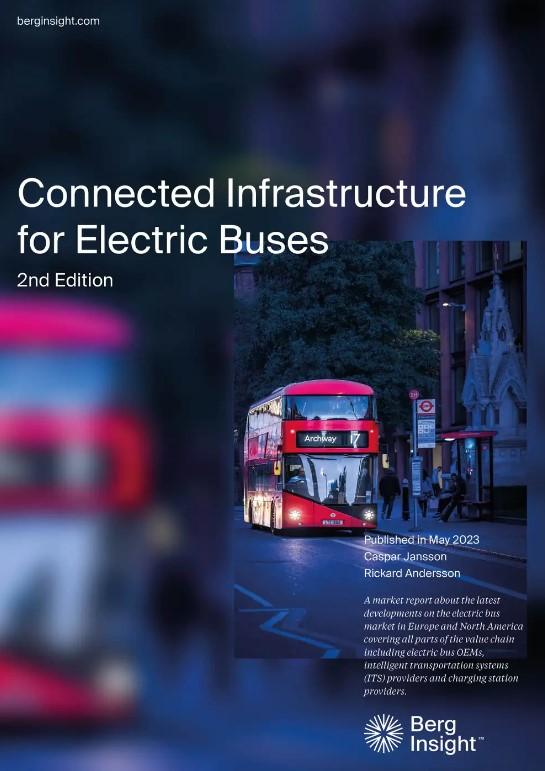
Today we published the new market report Connected Infrastructure for Electric Buses – 2nd Edition from Berg Insight which analyses the latest developments on the intelligent transportation system and charging station market for public transport in Europe and North America. This strategic research report from Berg Insight provides you with 210 pages of unique business intelligence, including 5-year industry forecasts, expert commentary and real-life case studies on which to base your business decisions.
The number of battery-electric buses has grown significantly in the last years. Berg Insight estimates that the number of electric buses in Europe and North America increased from about 1,000 in 2016 to around 16,000 in 2022. The growing fleets of electric buses have created new challenges for public transport operators and agencies.
Limited driving range and the need to integrate charging stations have expanded the demand for intelligent transport systems (ITS) that bring together all the necessary infrastructure, including electric buses, charging stations and depots. The term ITS refers to information and communications technology applied to transport infrastructure and vehicles.
Berg Insight’s definition of ITS for public transport for the purpose of this report includes systems for communication between dispatchers and vehicle operators, automatic vehicle locator systems and automated dispatching systems. Other associated back-office IT systems are also part of the definition, including depot management, driver monitoring, scheduling and planning tools for vehicles and personnel, vehicle maintenance and charging station management software.
Berg Insight is of the opinion that the market for ITS solutions for electric buses is in a growth phase which will last for several years to come. Mega-challenges such as urbanisation, climate change and traffic congestion continue to encourage investments in electric buses and ITS, contributing to a positive outlook for the market. The increased energy prices following Russia’s invasion of Ukraine and the supply chain issues following the COVID-19 pandemic have had limited adverse effect on the electrification of public transport.
The total market value of public transport ITS for electric buses in Europe is forecasted to grow at a compound annual growth rate (CAGR) of 39 percent from € 57.1 million in 2022 to reach € 297.2 million by 2027. Vehicle and driver monitoring software as well as vehicle gateways are together estimated to account for € 15.6 million of the market value in 2022, while the corresponding number for charging station management software is € 10.6 million.
In North America, the total market value of ITS solutions for electric buses is forecasted to grow at a CAGR of 30 percent from € 15.5 million in 2022 to reach € 58.2 million in 2027. Vehicle and driver monitoring software and vehicle gateways are estimated to account for € 4.1 million of the market value in 2022, while the corresponding number for charging station management software is € 2.9 million.
Some ITS players offer complete turnkey solutions including functionality for most of the ITS applications for electric buses utilised by public transport operators, but many vendors on the market are also specialised ITS players focusing on a few subsystems. Major international ITS players such as INIT, IVU, Trapeze and Clever Devices can provide complete turnkey solutions. INIT and IVU have customers mainly in Europe, while Clever Devices and Trapeze have stronger presence in North America.
Trapeze launched its solution for electric buses in 2020 and announced its first deployment in 2021. EQUANS is also a major global player and its CAD/AVL systems have been installed on electric buses both in Europe and North America. One of the leading telematics providers for electric buses is ViriCiti, which was acquired by ChargePoint in August 2021. Under the ChargePoint brand, the company offers hardware and software for the management of buses and charging stations in addition to a complete portfolio of charging hardware and software.
Other important providers serving public transport companies with different types of solutions for electric buses include the Scandinavian companies Consat Telematics, FARA and Saga Tenix. The Canadian company GIRO is an important player in the scheduling and planning segment, while PSI Transcom is a prominent provider of depot and charging management software in Europe.
Most of the bus OEMs on the market offer conventional telematics solutions, but the strategies in the area of electric bus specific solutions vary between the players. The European market for electric buses is served by a variety of manufacturers. The Chinese company Yutong reached the highest number of registrations in 2022, followed by BYD ADL, Mercedes-Benz, Iveco Bus, VDL and Solaris. In North America, Proterra holds a leading position, and other notable players include BYD and New Flyer (NFI Group).
Charging stations play a significant role in the electrification of bus fleets. Berg Insight estimates that the charging station market value for buses in Europe and North America was € 160 million in 2022. Growing at a CAGR of 46 percent, the total market value is expected to reach € 1.1 billion in 2027. A group of vendors have emerged as leaders on the market for bus chargers. Examples of major charging station providers active in both Europe and North America include ABB, Efacec, IES Synergy, Heliox and Siemens. In Europe, Polish Ekoenergetyka is also an important provider.
Highlights from the report:
Insights from 30 new executive interviews with market-leading companies.
New data on electric bus fleets in Europe and North America.
Comprehensive description of the electric bus ITS value chain and key applications.
Profiles of 22 aftermarket ITS solution and 14 EV charging hardware vendors.
Summary of 20 OEM propositions from electric bus brands.
Case studies of 11 electric bus initiatives.
In-depth analysis of market trends and key developments.
Updated market forecasts lasting until 2027.
This report answers the following questions:
What is the current state and size of the electric bus market?
Which are the leading providers of public transport ITS solutions for electric buses?
What offerings are available from vehicle OEMs?
What equipment and service offerings are available from EV charging station vendors?
What are the key drivers behind the adoption of electric buses?
How are the regulatory developments in Europe and North America affecting the electric bus industry?
How will the electric bus and public transport ITS industry evolve in the future?
Analysts: Caspar Jansson and Rickard Andersson
Formats: PDF + Excel user licenses
Publication date: May 25, 2023
Download brochure: https://media.berginsight.com/2023/05/25143514/bi-electricbuses2-ps.pdf
Pages: 210